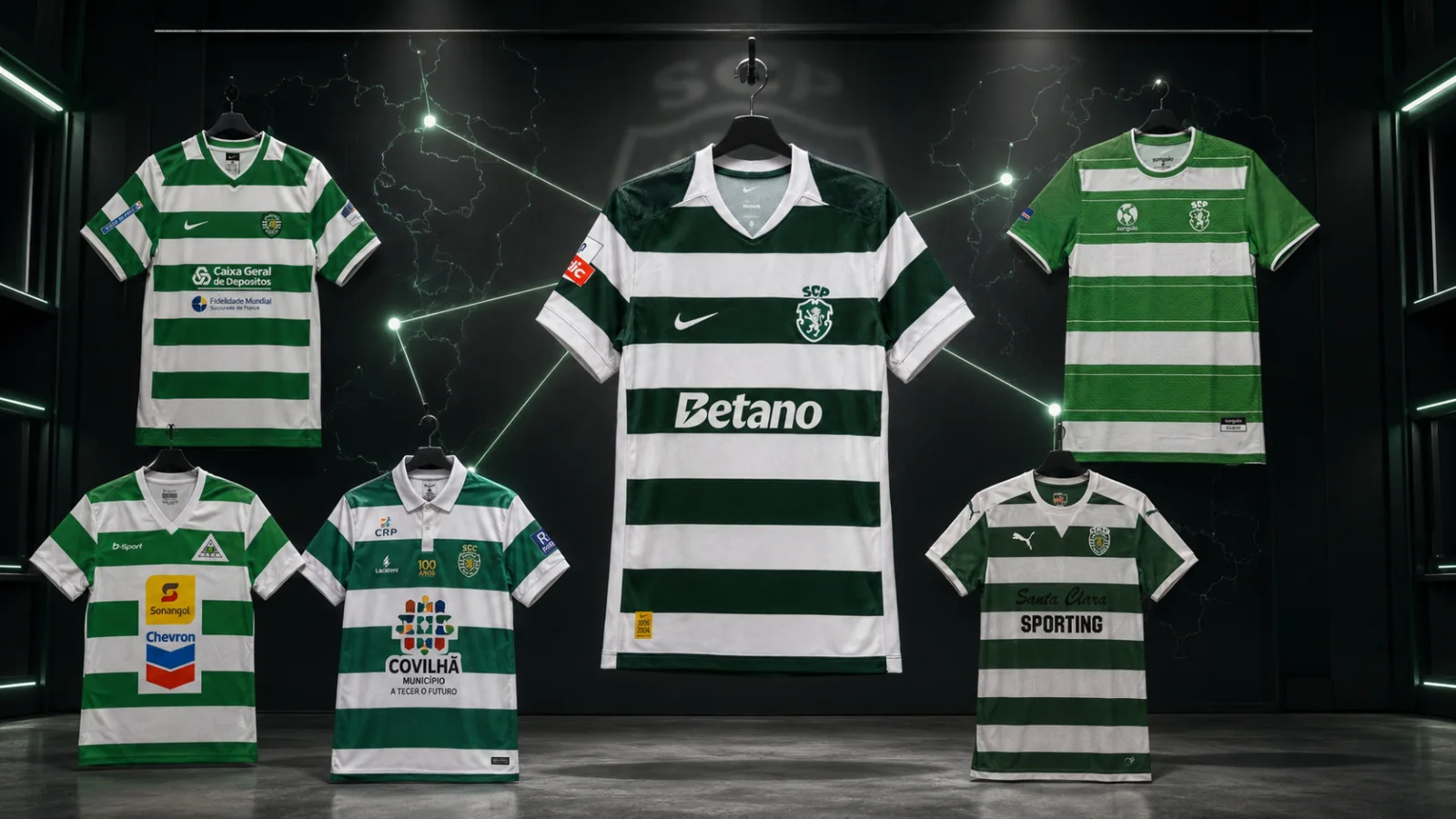
Some club names stay where they were born. And then there is Sporting, a name that emigrated. It left Lisbon in 1906 and never stopped: it crossed mountains, oceans and empires, was adopted by villages, parishes, oil enclaves and emigrant communities, and has reached this archive in seventeen different versions, as I write, spread across four continents. This article is the map of that diaspora, told through the shirts.
Everything starts with Sporting Clube de Portugal, founded in Lisbon by José Alvalade with his grandfather funding the dream. But what Sporting invented, perhaps without planning it, was an expansion system unique in Portuguese football: the numbered affiliates. Autonomous clubs, from towns large and small, that officially requested the lion, the hoops and an order number, like joining a brotherhood.
The oldest ones in the archive trace the geography of that brotherhood. Sporting Clube de Pombal is affiliate number 10, christened in October 1922 with a fitting ceremony: a match against Sporting de Tomar, affiliate number 1, which acted as godmother, and a crest that joins the Templar castle of Gualdim Pais to the lion of Alvalade. A year later the eighth affiliate was born in the city of wool mills: Sporting da Covilhã, which reached the top flight in 1948, finished fifth in 1955/56 behind only the giants, and played the 1957 Portuguese Cup final.
Then the name boarded a ship. In December 1923, affiliate number 20 was born in the capital of Cape Verde, today Sporting Clube da Praia, three times colonial champions before independence and one of the giants of the Várzea. In 1925, in the enclave that oil would make famous, came affiliate number 31: Sporting de Cabinda, renamed Petróleos de Cabinda after independence in 1975 without ever shedding the hoops, and officially reconnected to the mother house in the 21st century. In 1926 the name reached the Far East as affiliate number 25, Sporting Clube de Macau, which fell asleep and was reborn twice: in 1951 through António Conceição, and in 2008 through his son, in his father's memory, with a Macau championship in 1991 along the way.
In Portugal, the brotherhood kept adding numbers. The 63rd affiliate plays beside a baroque stairway of 686 steps: Sporting de Lamego, the dean of the city's sport and nine times district champions of Viseu. Number 132 was born in the Azores with a story fit for cinema: the first kit of Sporting Clube Ideal of Ribeira Grande crossed the Atlantic by boat, sent from the United States by an emigrant. Number 148 belongs to a rural village near Mafra that answered the outbreak of war in Europe by founding a football club: Sporting do Livramento, October 1939, motto Attitude, Strength, Union. And number 143 proves the brotherhood emigrates too: Sporting Clube de Paris, founded in 1983 in the 13th arrondissement to make sport an engine of cohesion for the Portuguese community in France.
But the lion's diaspora does not end with the numbered affiliates. There are those who chose the name out of pure devotion. Sporting de Cabreiros, in a rural parish of Braga, has dressed in the image of Alvalade since 1932, like so many namesakes sown across the Minho. Sporting Ferreirense was founded in 1955 by the parish priest of Ferreira do Alentejo, a man who also recorded thousands of hours of Alentejo cante alongside Lopes Graça and Giacometti. Sporting de Guadalupe was born the same year on Graciosa island, inside the headquarters of the local philharmonic band, club and band growing up door to door. Sporting de Torres, from 1929, has no affiliation at all, and made roller hockey its soul. And some are not even Portuguese: in Calabria, Sporting Corigliano is a biancoverde football school awarded by the Italian federation for more than twenty consecutive years, and in Silicon Valley Santa Clara Sporting, founded in 1971 by Portuguese emigrants, drew its crest in the image of Alvalade's and became one of the most decorated youth clubs in the United States, with hundreds of active players.
And then there is the case that is not a football club at all: Sporting CP/Tavira, the name used by the Tavira Cycling Club team between 2016 and 2019, when the lion returned to the peloton after almost two decades away. The Algarve partner is considered the oldest professional cycling team in uninterrupted activity in the world. Even on a bicycle, the name travels.
Placed side by side, these shirts tell a story no official museum tells: that of a club multiplied by people who never set foot in Alvalade. Priests, philharmonic bands, emigrants, oil workers, cyclists. The lion belonged to them all.
Here at Hoopster, the lion's diaspora remains open: there is always an affiliate, a namesake or a devotion left to discover, and the archive will dress them all.