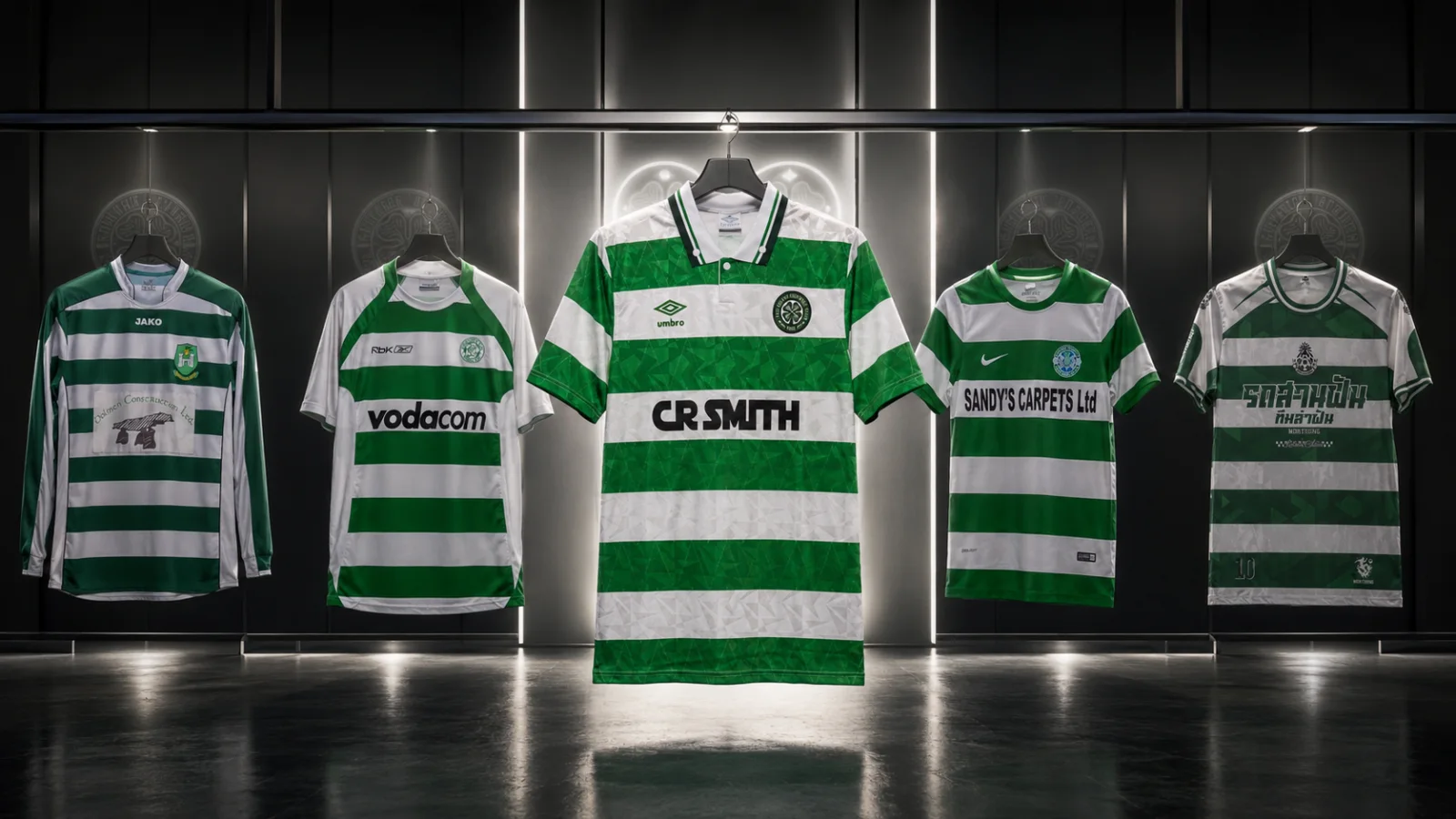
Celtic was born in 1887 in a parish hall in Glasgow's East End, founded by Brother Walfrid, an Irish Marist, with a purpose set down in black and white: to raise money to feed the children of the city's poorest Irish immigrants. A club created to feed people ended up giving something else, harder to measure: identity. The horizontal stripes arrived in 1903, the Lisbon Lions conquered Europe in 1967, and along the way Celtic became one of football's rarest cases, a club that other clubs, on other continents, chose to imitate of their own free will. This article walks through that lineage, piece by piece.
The oldest daughter in the archive is Scottish and comes with a delicious legend. Buckie Thistle, from a fishing town of seven thousand people on the Moray Firth coast, was born in 1889 and wears green and white hoops that, local tradition says, arrived in a donation of shirts from Celtic themselves. The delicious detail is that Celtic only adopted their famous hoops in 1903, which makes the legend a fine example of how supporters' memory rewrites history in the image of what it loves. True or myth, the Jags joined the Highland League in 1909 and have been, for over a century, a Celtic in miniature.
The second story begins with Rome still smouldering from the war. In 1944, a group of shopkeepers from the Appio-Latino district founded A.L.M.A.S., an acronym for Appio Latino Metronio Associazione Sportiva, led by an accountant and a former Lazio player, with a panda for a symbol and registration number 1620, among the oldest in Lazio football. And they took a decision that would one day bring the club to this archive: to dress in white and green in the image of Glasgow Celtic. The Almas shirt that lives here shows that, eighty years on, the choice still stands.
The third is the one that gave birth to this site, and anyone who read the blog's opening article already knows part of it. But there is a detail of the Celtic Castilla story that deserves this chapter: the club of the Colégio Castilla boys in Tetuán was not born Celtic. Its first name was Celta de Castilla, a tribute to Celta de Vigo, and the first shirts were sky blue. It was the Europe conquered by the Lisbon Lions that converted Madrid: Celta became Celtic, sky blue became hoops, and so it remains today in the Madrid regional divisions.
The fourth crosses the hemisphere. In 1969, at the height of apartheid, Norman Mathobisa and Victor Mahatane founded Mangaung United in Bloemfontein. In 1984 businessman Petrus Molemela bought the club and named it after Glasgow Celtic, inheriting the green and white hoops. Bloemfontein Celtic was born, the Phunya Sele Sele, whose modest trophy cabinet never got in the way of what mattered: the Siwelele, the stand that sings from the first minute to the last, made it one of the most beloved clubs in South Africa. Proof that Celtic's inheritance was never about trophies, it was about the stands.
And there is one more piece that closes the circle by another road: the O'Neills Celtic Cross, a shirt that represents no club at all. Green and white hoops, a Celtic cross and the Gaelic inscription In Éirinn tá Neart, made by the historic brand of Gaelic football and hurling. It is Ireland's homage to the identity Glasgow gave back to the Irish of the diaspora: the pattern returning home, no longer needing a club to exist.
Four clubs in four countries, plus one shirt with no club, all pointing back to the same parish hall of 1887. Brother Walfrid wanted to feed children. He ended up dressing the world.
Here at Hoopster, this lineage has a reserved seat: every new Celtic-inspired piece that arrives is another branch of a family tree that started in the East End and has never stopped growing.