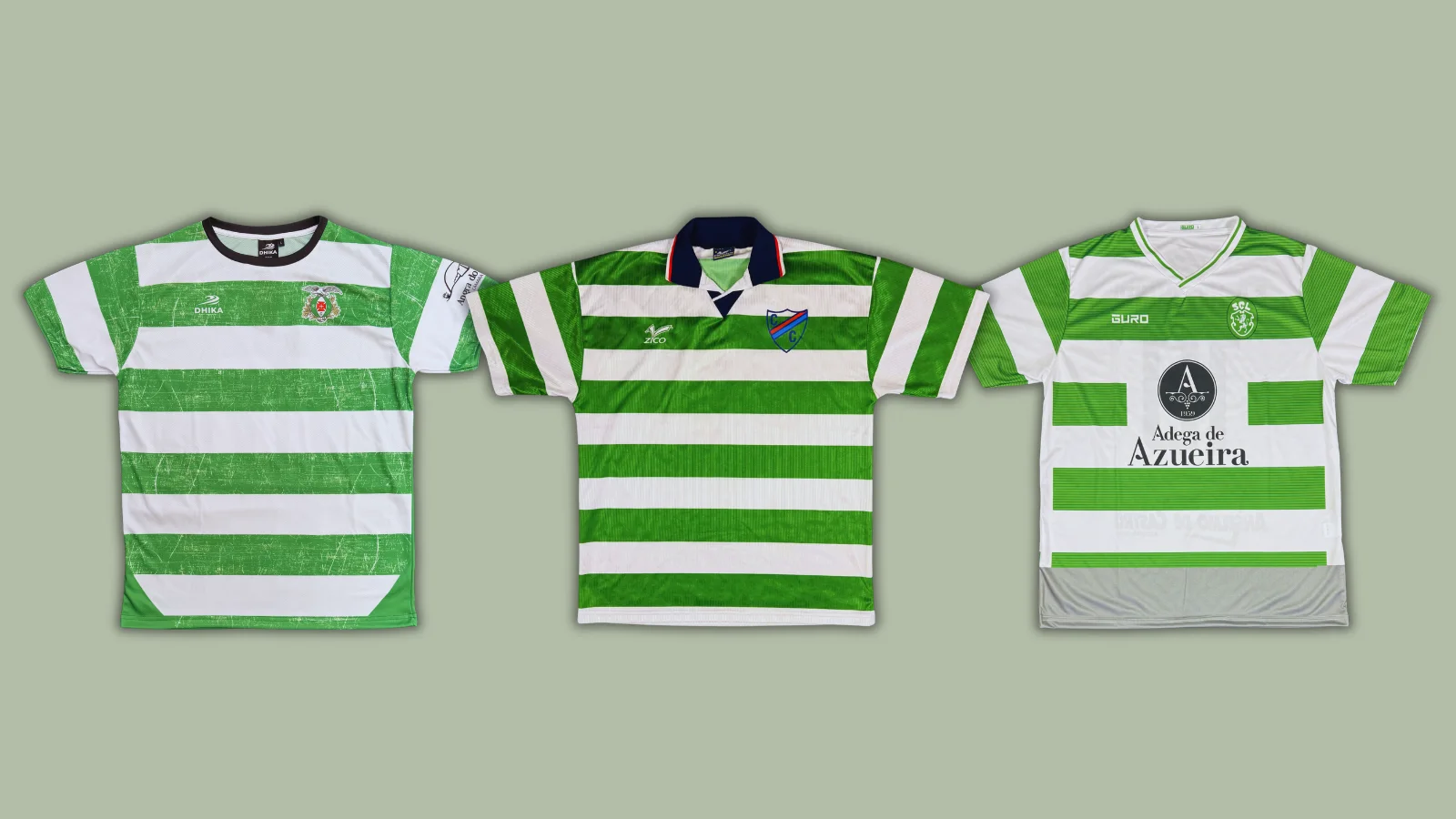
Every collection should have one piece that explains it. Hoopster's is a Spanish shirt from 2000/01, polo cut, navy collar, green and white hoops, made by a Galician brand founded by a former professional cyclist. On the crest, two crossed letters: C.C. Celtic Castilla.
The story behind those two letters is the reason this site exists.
In 1969, in a working class Madrid neighbourhood called Tetuán, a group of young men ran a modest club with a perfectly normal name: Celta de Castilla. That year they decided to change it. Not to something more commercial, nor more Madrilenian. They chose the name of a Scottish club more than two thousand kilometres away which, two years earlier, on a May afternoon at the Estádio Nacional in Portugal, had become the first British champions of Europe. Celta de Castilla became Celtic Castilla, put on green and white hoops, and never took them off.
Think about what that means. Nobody forced those young men from Tetuán into anything. There was no marketing, no cable television, no replica shirts for sale. There was only a pattern of green and white horizontal stripes that had crossed Europe and lodged itself in the minds of everyone who saw it. It was a choice made out of love, and that phenomenon is exactly what Hoopster collects.
Because this site is not a collection of one club's shirts. It is a collection of one pattern's shirts.
The pattern has its famous mother houses. In Glasgow, Celtic, founded in 1887 by a Marist brother to feed the poor of the East End, has worn hoops since the start of the twentieth century. In Lisbon, Sporting turned green and white into a national identity. But what makes the pattern fascinating is not the cathedrals, it is the chapels. It is discovering that it appears, again and again, in the places where nobody was looking.
It appears on an Atlantic island, where Lusitânia of Angra do Heroísmo stitches a goshawk and a hydrangea onto the stripes. It appears in a village near Mafra, where Livramento carries on its chest the cooperative winery that has bottled the parish's wine since 1959. It appears in the Thai province of Prachinburi, guarded by a snarling Hanuman. It appears in San Juan, Puerto Rico, on an island where football lives in the shadow of baseball. It appears in Rome, where Almas, founded in 1944, chose the hoops for the same reason as the young men of Tetuán: because they saw Celtic and could not forget. It appears on dusty pitches in Puglia, in Mostaganem in Algeria, in Gdańsk in Poland, at a rugby club south of Milan with a boar on its chest.
As I write this, the archive spans half a century of shirts and some fifty countries across four continents. None of those pieces was chosen for being valuable. Many cost less than a matchday ticket. They were chosen because each one proves the same thesis from a different angle: green and white belongs to no club, no league, no country. It is a language. And like every living language, it is spoken with accents.
There are rules to this collection, few but firm. The first: the stripes rule. Horizontal by preference, the classic hoops, but the pattern accepts regional variations the way any language accepts dialects. The second: the story is worth more than the condition. A match worn shirt from a full back in the Italian Prima Categoria, its leatherette number half peeling off, says more than an immaculate replica sealed in plastic. The third: the small clubs come first. The giants have people to archive them. Porto Fuori of Ravenna, with the corner opticians on its chest, has nobody else. That is why this archive spends more time in the Promozione than in the Champions League.
And then there is the rule that is not a rule but a consequence: every shirt pulls in the next one. It was while researching the history of one Puglian club that its rival from the other end of the region appeared, wearing the same template from the same Parma factory. It was by following Sporting's trail that the collection reached Praia, Macau, Cabinda and Paris. The pattern is a web, and this site is the attempt to map it, entry by entry, with each piece's season, brand, club, city and story documented in both languages.
Celtic Castilla still plays today, in the regional divisions of Madrid, in the same colours it chose in 1969. The shirt that opens this text is kept here, between a piece from Alvalade and another from Parkhead, which is exactly where it always wanted to be.
Here at Hoopster, this is the map we are drawing: a pattern nobody invented alone, and one that has already travelled the whole world. Welcome. The stripes are the same everywhere. What changes is the story of whoever wears them.